
Bessemer City Directory Collections
The most exact guide to surviving Bessemer volumes is the Alabama Department of Archives and History finding aid LPR104. It identifies the city material in boxes 11 and 12 and lists each issue rather than implying complete annual coverage. The publisher is not named in that finding aid, so it should not be supplied from assumption.
| Collection | Verified years | Repository | Access route |
|---|---|---|---|
| Standalone Bessemer directories | 1907; 1913-14; 1916-17; 1920-21; 1938; 1940; 1946; 1948; 1951; 1953; 1955; 1957; 1959-61; 1963 | ADAH, LPR104 boxes 11-12 | Onsite research or archive request |
| Bessemer telephone books | 1937-44; 1948-49; 1962-63 | Library of Congress | Free page images and PDF |
| WPA Bessemer marriage indexes | 1916-38 and 1916-37 series | ADAH | Finding aid and archival request |
| Bessemer Journal | Dates not verified | Birmingham Public Library microfilm inventory | Call before a visit |
| Federal census | Public through 1950 | NARA and library databases | Free NARA tools or library access |
Seventeen standalone editions or issues are verified between 1907 and 1963. The gaps are real limits in the located inventory, not proof that no other issue was ever printed. Jefferson County Metropolitan editions exist for 1998 through 2004, but Bessemer coverage must be checked in the volume before it is treated as part of this sequence.
Access also changes by collection. The state archive route is an onsite visit or a request tied to the finding aid. The telephone books can be examined from home, page by page. Newspaper microfilm needs a call to confirm the reel dates, while NARA census access follows the federal release schedule. Naming the repository and the exact issue in research notes makes the next check repeatable.
Seventeen Bessemer Directory Issues
The state archive's year list supplies a useful timeline. It begins with two copies of 1907, resumes with two copies of 1913-14, then moves through 1916-17 and 1920-21. The next verified issue is 1938. Later points are 1940, 1946, 1948, every other year from 1951 through 1959, then 1960, 1961, and 1963. A researcher should cite the actual issue viewed, not flatten this into a continuous 1907-63 run.
1907: earliest verified standalone issue, held in duplicate.
1913-21: four dated issues or combined-year editions survive in the finding aid.
1938-49: archive issues and digitized telephone runs begin to overlap.
1951-63: a denser sequence ends with the verified 1963 issue.
This chronology sits across a city founded in 1886 and incorporated in 1887. Bessemer Probate books begin in 1915, but the directory shelf starts earlier. The two record types therefore answer different questions, and the city directory may supply an address clue before the separate Bessemer courthouse deed sequence begins.
A mid-1930s fire affected a Bessemer municipal building, but it must not be used to explain absent county deed books. The county land archive has its own verified dates. Likewise, sources disagree on whether the satellite courthouse began in 1915 or 1920, while legal history points to earlier legislation and a 1919 recreation. A careful narrative preserves that conflict instead of choosing a convenient date.
Library of Congress Bessemer Directories
The Library of Congress Bessemer telephone-book viewer is the strongest remote route. Its verified runs cover 1937-39, 1940-44, 1948-49 Yellow Pages, and 1962-63. Users can browse page images, use OCR as a first pass, or obtain the PDF. OCR helps locate a surname, but a page image should settle spelling, punctuation, and column order.
The manifest image below comes from the Library of Congress Sanborn guide used to locate and interpret map-based companions to directory research. It is useful context, but the research did not verify specific Bessemer Sanborn years, so a volume should be confirmed in the catalog before it enters a family timeline.
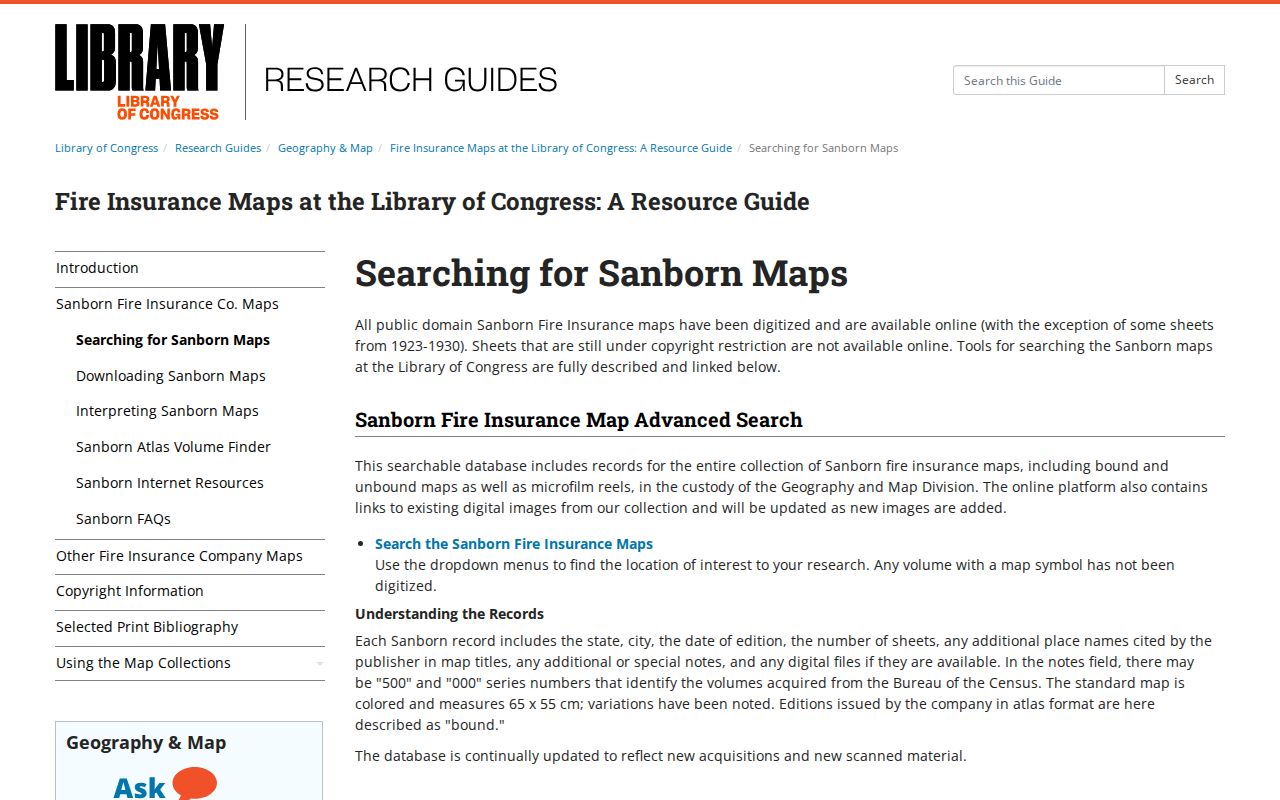
Maps can test whether an address or building form fits a directory clue, while the named resident still comes from the directory, census, deed, or another people record.
Reading a Bessemer Directory Listing
The digitized telephone books establish what their own entries contain. Alphabetical listings show a subscriber or business name, street number, street abbreviation, city or exchange, and telephone number. Classified pages add a heading and may give a proprietor or manager, services, an address, display copy, and cross-references. Those are observed fields; spouse, ownership, and boarder marks should not be assumed unless the chosen issue's key defines them.
| Subscriber or business | The listed name, which may represent only the telephone account. |
|---|---|
| Street line | House number, directional, and abbreviated street name as printed. |
| Exchange and number | An older Bessmr-style number or a later 425/428 exchange. |
| Classified detail | Category, services, and sometimes a proprietor or manager. |
| Cross-reference | A pointer to another heading, business name, or display advertisement. |
- Criss-cross directory
- A directory arranged by street address or telephone number rather than only by surname. Its presence must be verified in the actual volume.
- Householder index
- A name or address aid for locating the person treated as the listed householder, not a complete roster of occupants.
- Abbreviation key
- The volume's own guide to shortened streets, occupations, status marks, and other symbols. Save it before interpreting an entry.
Bessemer Exchanges Date Directory Clippings
A small typographic clue can narrow time. Older listings use a Bessmr-### pattern, while later books show 425 or 428 exchanges. When a clipped entry has lost its cover and date, compare the number form, street spelling, and nearby businesses against intact issues. The exchange alone is not a final date, but it can identify the best group of volumes to inspect.
One observed classified example names Central Foundry, gives a plant manager, and places the operation at 730 N 22nd with Bessemer exchange numbers. That shows why classified pages matter: they can connect a person, organization, location, and telephone format in one item. A citation should still include the page and issue once the matching volume is found.
Bessemer's Segregated Marriage Indexes
The ADAH WPA holdings inventory documents race-segregated Bessemer marriage-license indexes. The White series has volumes 1 through 13 for 1916-38. The Black series has volumes 1 through 17 for 1916-37. Researchers must check the historically appropriate series and preserve the archive's original description while recognizing the segregation that created separate access paths.
The ADAH inventory source page is shown below because the manifest captured it successfully. It is an index guide rather than a marriage certificate or full file, so it directs a request and does not replace the underlying record.
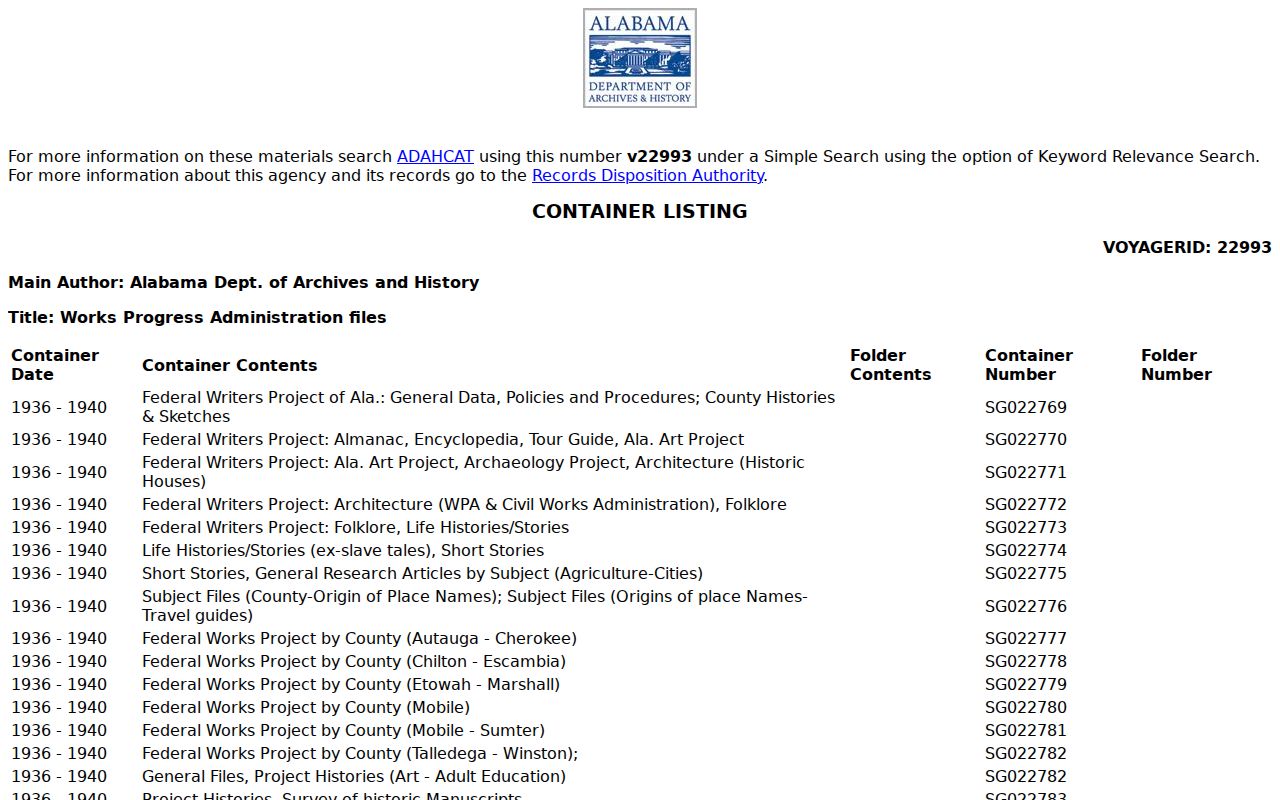
A directory address near a marriage year can help distinguish two same-name couples. The marriage index can then point toward Probate holdings, where the access route depends on date and issuing division.
Trace Bessemer City Directory Years
A careful sequence uses the directories as dated snapshots and the census as a broader household record. The public federal census now extends through 1950, so the 1920 and 1940 schedules pair especially well with nearby Bessemer issues. Telephone books narrow the gap between census years but omit unlisted people and households without service.
- Start with a known name, approximate year, and one independent fact such as a relative or street.
- Search the closest issue, then read the actual image and record the entry exactly as printed.
- Check the prior and next verified issues for moves, spelling changes, or a new exchange format.
- Compare a 1920 or 1940 clue with the matching census household and preserve any discrepancy.
- Use deeds, marriage indexes, newspapers, probate files, or manuscript collections to test the link.
Disappearance can mean a move, death, changed name, no telephone, or a skipped publication year. For a modern check after a historic find, use the Bessemer resident lookup workflow and require two independent matching facts.
Beyond Bessemer's Printed Directory Shelf
The Bessemer Public Library is at 400 19th Street North and can help a researcher test local holdings, newspapers, databases, and interlibrary-loan options. Published hours are Monday and Thursday 9 a.m. to 8 p.m.; Tuesday, Wednesday, and Friday 9 a.m. to 6 p.m.; and Saturday 10 a.m. to 4 p.m. Call 205-428-7882 before traveling to confirm the exact volume, reel, or authentication needed.
This library view comes from the official Bessemer Public Library history page. The institution began with a free library organized in 1905, opened a Carnegie building in 1907, moved into the Old Post Office in 1967, and completed a major enlargement in 2008.
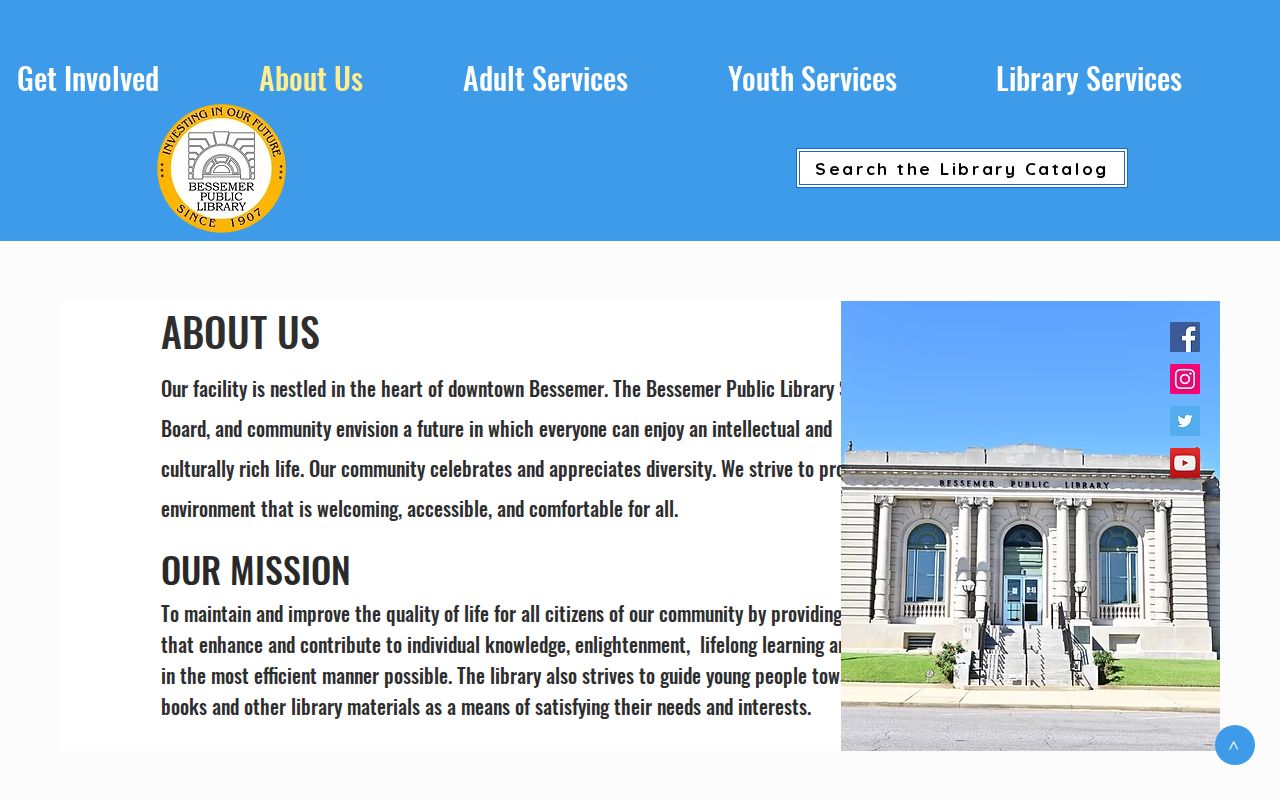
Other archives supply voices the printed city directory cannot. The University of Alabama's Henry DeBardeleben records cover 1886-1953 company minutes, stockholder letters, certificates, and legal or financial papers. Bessemer Hall of History holds local photographs and artifacts, though no official catalog or research fee was verified. These sources can rebuild founding and industrial networks before the first known 1907 issue or between shelf gaps.
ADAH's 2023 Spirit of Steel accession adds interviews, photographs, recordings, and records from mining, railroad, and mill communities, including the Bessemer-based CIO Singers. The county subject files also cover Bessemer, annexation, schools, major churches, and the Hall of History. Together, those sources can explain an occupation or community tie that appears in a brief directory line. They should be cited as companion evidence, since a manuscript name does not by itself prove residence at the printed address.